A refugee said "I cannot go back to my country because of the following points: 1. Imprisonment and Persecution 2. Torture and punishment 3. Electric torture 4. Beating with the stick on the feet (corporal punishment) 5. threatening me to be killed 6. Lack of human rights organizations which can lobby against human rights violation in the country. 7. Threatening to abuse my family members. 8. Demolition of my house. Due to all that I can’t go back".

Home Page

Mar 29, 2011

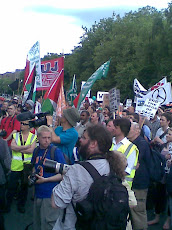
IRISH ANTI-WAR MOVEMENT PROTEST: NATO Bombing and the no-fly zone

IRISH ANTI-WAR MOVEMENT PROTEST
Monday,28 March 18:00 - TODAY
Molesworth St Outside the EU Offices
NATO bombing is no solution
Full support for the Libyan uprising
No more western backing of tyrannical regimes
1. NATO bombing, no solutionJust eight years after they launched their shock-and-awe devastation of Baghdad and ten years after their invasion of Afghanistan, the same Western forces are pummelling yet another Muslim state with bombs, burning soldiers and tanks and killing civilians in the process.


Yet again, the claim is that their intervention is a question of moral principle. The passing of the UN security Resolution 1973 which authorised the bombing, was held up as an attempt to protect the Libyan rebels and stop Gaddafi brutally slaughtering his people. Why, then, did the same Western powers provide Gaddaffi with the arms that are now slaughtering the Libyan people?


Had NATO and the UN really wanted to support and protect the rebels, they could have acted differently. They could have sent arms directly to the rebels and dispatched anti-aircraft weaponry to Benghazi, Alzentan and Zintan, near the Tunisian border, and dropped weaponry and supplies to the rebels besieged in Ajdabiya and Misrata. They could have offered medical help and followed the example of many Libyan doctors in exile who hastened home to offer help to the injured. They could have simply united in recognising the Benghazi based National Council as the legitimate government of Libya.


So where lies the justification for the intervention? With 39.1 billion barrels of high quality oil reserves, and with the price of oil rising above $105 per barrel, western oil companies are keen to maintain their access to the Lybian oil fields. BP has huge investments there, but Italy and Spain are large buyers of Libyan oil, and most major European companies operate in Libya, including Spain's Repsol, Italy’s Eni, France's Total, Germany's Wintershall and Austria's OMV. As with Iraq, we cannot ignore that the question of oil looms large in this military intervention.

The NATO bombing has failed to halt the fighting or force Gadaffi’s forces into submission. It is actually making things worse. This is why even the dictator dominated Arab League have said that the bombing has gone well beyond a no-fly zone from the outset. The African Union has condemned the bombing as unjustified intervention in a civil war. These misgivings led Russia China Brazil, Germany and India to abstain in the original UN vote. Even in Britain, despite it being the first days of the military campaign, 43% of the population have already said they are against the action. The IAWM, too, calls for an immediate end to the bombing.

2. No partition and full support for the Libyan uprising and the Arab revolutions.
The IAWM gives its full support to the Libyan uprising. It condemns the hypocrisy of western governments which despite their humanitarian rhetoric, have failed to respond to the basic demands of Libya’s Transitional National Council (TNC). It asked for the recognition of the TNC, access to the billions in sequestrated regime funds in order to buy weapons and other crucial supplies, and an immediate halt to the “mercenary flights” that provided Gaddafi’s regime with its foot soldiers. Western governments refused to accept any of these demands. They objected to weapons sales as they said these could fall into the hands of “Islamist terrorists.” The western powers sought to
protect their own interests. They demanded that any future Libyan government would honour all contracts signed by Gaddafi, including oil concessions. They demanded that the strict repression of “Islamist” movements continue, and that any future government
maintain Libya’s role as a guardian against African migration into southern Europe. In other words, western intervention came at a price.

The NATO bombing is part of a wider western political strategy for the region. Cameron and Sarkozy, cheerleaders for this initiative, fear that the Arab uprisings may get out of hand and threaten to overturn their cosy relationships with the middle eastern regimes. They believe that it is time to put their stamp back on the region and force a halt to further radicalisation of the pro-democracy movements. Amr Moussa, former
foreign minister under Mubarak, prospective Egyptian president, and the head of the Arab League which agreed to back the UN resolution, represents the kind of interim government which the EU and the US would welcome.

Rather than pursuing a strategy which would further isolate Gaddafi, the west have turned their backs on the very forces that could help the Libyan rebels the most. They have ignored the repression occurring in the Yemen, Bahrain or Saudi. Instead of supporting other movements of protest across the region, they have effectively allowed dictatorial regimes to continue undisturbed. France clung on to supporting Ben Ali in Tunisia, in the beginning even offering to send their own riot police to help put down the protests. The Egyptian revolution was left on its own to force Mubarak from power. The brutal suppression of the protests in Yemen have been passed over in silence and the EU’s Catherine Ashton has defended Bahrain’s violent repression of pro-democracy protesters.

The only people that the Libyan rebels can trust are their fellow Arab peoples who are fighting courageously the same brand of tyrant as their own. If Libya’s neighbours, Egypt and Tunisia, lent their support – military, logistical, and practical – to the rebel strongholds in Libya, then that would help the Arabs peoples to take control of their revolutions. The best use that Egypt could make of the $1.3bn of military aid that it gets from the US would be to arm the Libyan rebels. Such measures would help to prevent an outcome that the west looks increasingly likely to favour – the partition of the country into a rebel-held east and a Gaddafi controlled rest of the country.

3. Ireland should recognise the Libyan National Council and call a halt to the NATO intervention.
The IAWM believes that our government should not close ranks behind the NAT0 bombing of Libya. Fine Gael has made no secret of its desire to increase Ireland’s cooperation with EU-NATO cooperation. Nor has it hidden its sympathy with Israel’s agenda in the Middle East. This FG led government looks set to increase Ireland’s military commitment to humanitarian intervention.

The only comments of our new Foreign minister on the crisis unfolding in Libya has been to hide behind the letter of the UN mandate. Eamon Gilmore has said that resolution 1973 “did not extend to regime change” in Libya and “must be confined to the protection of the civilian population”. We believe that among many people who voted for the Labour Party there is unease about where this military campaign will lead. It is simply not good enough for Eamon Gilmore to hide behind platitudes.

We call on Ireland to recognise the Libyan Transitional National Council and call a halt to the NATO bombing.

www.irishantiwar.org | infor@irishantiwar.org


URGET NILESAT TO STOP BROADCASTING STATE TV INSIDE LIBYA


The Gaddafi Regime has lost its legitimacy by orchestrating ongoing campaigns of violence and murder on Libyan people. Estimates of the death toll vary. According to Wikipedia it may be upwards of 6,000 while the Interim Government places it at over 8000. Yet State Run TV continues to broadcast and be used by the regime to incite violence against innocent Libyan civilians. Gaddafi has banned all media broadcasts inside Libya except for his 3 channels. They all rely on Nilesat satellites to broadcast.

Tell Nilesat to shut down Gaddafi TV!

UN Security Council (UNSC) resolutions and sanctions have been enacted with strong support from the international community. The sanctions include cutting off assets to the regime, travel bans and penalties on companies starting new business in the country. Despite the sanctions Gaddafi continues to terrorize and murder civilians. Recently a no fly zone was put into place by the UNSC to protect the people from violent attacks by the Gaddafi regime and a likely massacre against the million people living in Benghazi. The no fly zone was enacted at the urging of the Arab League and the Libyan people themselves.

Despite these measures by the international community Nilesat and other corporations continue to provide a platform for the Gaddafi's regime to spread its terror propaganda to the Libyans citizens and people around the world. Furthermore, there have been reports from Libya that coded messages have been disseminated to Gaddafi’s mercenaries and security forces via Al-Jamahirya satellite TV channel. Please tell these corporate service providers to stop broadcasting all of the Gaddafi regime’s satellite channels immediately. Tell them to stand with the international community and do their part to protect the Libyan people.

Sign the petition and then share it widely with your friends.


http://www.change.org/petitions/shut-down-gaddafi-state-tv#?opt_new=t&opt_fb=f


Mar 25, 2011

BAHRAIN – THE KEY TO THE ARAB UPRISINGS


BAHRAIN – THE KEY TO THE ARAB UPRISINGS

by

Dr. Abdullah Sayegh and Jim Roche, Steering Committee IAWM.

The actions of western leaders in recent weeks show the disdain in which they hold the ordinary people of the region, including Libyan people. Contrast their expressed “deep concern” for the fate of the Libyan people with the mild commentary regarding the current treatment of protesters in Bahrain. The U.S. government—through its proxy/puppet monarchy in Saudi Arabia—is arming, financing and sending troops to Bahrain to violently suppress the protests that have been happening for weeks.

The Bahraini authorities, western leaders and the UN are playing the sectarian card against the protesters – invoking yet again, as occurred previously in Iraq, a conflict between Shiia and Sunni Muslim, and of course, the demonization of the great regional evil - Iran.

The protesters on Pearl Roundabout were mainly Shiia, due to the awful discrimination in all aspects of work and cultural life against this larger demographic group by the ruling Sunni elite. Yet many Sunnis were prominent amongst the protesters, including those arrested, thus exposing the sectarian motives of the Bahraini authorities, Western leaders and the UN.

The protests in Bahrain link back to a wave of protests beginning in 1994 that were unique in its time for the level of cooperation between religious, secular and leftist / labour forces. Though inspired by the recent wave of Arab protests in the region the demands being made by Bahrainis today are the same as they were in 1994 namely, the release of political prisoners, the granting of political rights to women, and economic reforms to raise the standard of living of the majority Shia population.
Bahrain was, on 14 March, invaded by a foreign army consisting of troops from Saudi Arabia and the United Arab Emirates, with the stated purpose of protecting essential facilities including oil and gas installations and financial institutions and to "safeguard security and stability". The maneuver was carried out under the aegis of the Gulf Cooperation Council that also has Kuwait, Qatar and Oman as members, in contravention of international law and any sense of human decency.

The US administration has publicly declared that this is “not an invasion!

The Bahraini security forces and the invading Saudi army brutally attacked the peaceful protesters who were camped out on Pearl Roundabout resulting in many deaths and more than one thousand injuries. Hospitals are now under siege and are short of medicines. Ambulances have been stopped from collecting the wounded. There has been inhumane treatment of doctors, including a Dr. Akri who once worked in Dublin, and protesters have been injured beyond imagination. The Minister of Health has resigned due to these attacks on doctors and the Chief of the Sulaimani hospital has been replaced with a military officer. The imprisonment and house arrest of many leaders of the uprising is ongoing, helped by an imposed nightly curfew from 4pm to 4 am.

The suppression in Bahrain is, in proportion to the populations of both countries, as bloody a situation as Libya. Yet, compared to the grand standing of western leaders and now the military intervention in Libya, the mild condemnation by Hilary Clinton and other western leaders of the Saudi’s invasion of Bahrain and subsequent violent suppression of the peaceful protests, is astounding, matched only by the mild media coverage of the suffering of the people in Bahrain.

There are strong indications that this action by Saudi Arabia had the green light from Hilary Clinton. The timing of the Saudi intervention came after US Government officials met the Bahraini government leaders. Saudi troops drove across the border only two days after secretary of defence Robert Gates was in Bahrain, ostensibly attempting to convince the Bahraini leadership to engage in a more rapid process of dialogue and reform.

The Bahraini uprising will play a pivotal role in the future of the area. Many demonstrations are occurring now in the Eastern Saudi provinces and there are many skirmishes between ordinary people and the state forces.

The struggle of ordinary people for their democratic rights in an area governed by corrupt regimes, who maintain power only through the support of western political leaders, will win out in the end.

The struggle of ordinary people who believe that citizenship means equality of opportunity and not divisions between sects and tribes, a lazy excuse always used to divide people, will win out in the end.

The struggle of ordinary people who wish to express solidarity with the oppressed Palestinian people will win out in the end.

The struggle of ordinary people against those leaders who try to divert Arab people to think purely that “Iran is the enemy” will win out in the end.

The success of the Bahraini people in struggle will not only affect the regimes in the Arab side of the gulf, but it could also spread democracy throughout the Persian side of the Gulf, namely in Iran. That may explain the Iranian condemnation of the Saudi intervention being as mild as that of America.

Anti war activists must hold firm and support the demands of Arab protesters for democratic change, argue against the sectarian card being played by regional and western powers and point out the duplicity and hypocrisy of western leaders in their reluctant support for some protests while they remain silent, or at best ambiguous on others, and in their devious manipulation of the genuine struggles of the Arab people for democracy and freedom versus the interests of western multinationals and military machines.

Dr. Abdullah Sayegh and Jim Roche, Steering Committee IAWM. 18 March 2011

--
Click here to unsubscribe from this newsletter
Nuclear devastation in Japan will have worldwide health repercussions, and soon
IAWM PRESS RELEASE - 20 MARCH 2011

Nuclear devastation in Japan will have worldwide health repercussions, and soon

The nuclear crisis in Japan, with effects occurring in all six reactors on the site in question, is now officially ranked as level 6, and it is not yet resolved, if it ever can be. To put this in context, Chernobyl was ranked as level 7. The US is expecting nuclear contamination to hit there within about two days, and Western Europe later. There has been and will be increased seismic activity worldwide, and there are other reactors built in fault zones. Japan's disaster will become the world's disaster.

In February and March, earthquakes have occurred along the 'ring of fire' - Chile, New Zealand, Japan. If this continues, the west coast of North America might take the next hit. Geologists are predicting it. The washing up of fish and whales on beaches probably has to do with electromagnetic disturbances underwater which could presage earthquakes and tsunamis.

Japan was the most prepared of all countries, or so they thought. They had huge walls to protect against tsunamis. They had nuclear backup systems - but they did not calculate on an earthquake as high as level 9 on the Richter scale. So their protective measures were not enough. Once again, an improbable chain of events has happened.
They are now at the point where workers will be asked to volunteer on a suicide mission- to sacrifice themselves to 'save Japan' by going into the deadly radioactive areas to try to fix the problems, get electricity supply back to run pumps, etc.. As this was never foreseen as a possibility, there are no manuals to follow telling them how to deal with six reactors in a meltdown or potential meltdown process.

Glenda Cimino from the IAWM Steering Committee said:
"The only protection now against nuclear disaster for the world is to SHUT DOWN THE NUCLEAR POWER PLANTS and do not let them build any more. With every new generation of nuclear plants, we are reassured that these are much safer than the last. But they will never be safe enough to protect us from the possibility of radiation exposure, with the inevitable trail of cancers, childhood leukemias, birth mutations for generations, and poisoned water and food."

For further info contact:
Glenda Cimino, Steering Committee IAWM. Tel. 086 124 9456

--
Click here to unsubscribe from this newsletter

IRISH ANTI-WAR MOVEMENT (IAWM) - PRESS STATEMENT – 20 MARCH 2011

PRESS STATEMENT – 20 MARCH 2011

On the 8th anniversary of the disastrous US led invasion of Iraq in 2003 the Irish Anti-war Movement says:

• WESTERN MILITARY INTERVENTION IN LIBYA COULD MAKE THINGS WORSE FOR THE LIBYAN PEOPLES’ STRUGGLE FOR FREEDOM AND DEMOCRACY
• DO NOT TRUST WESTERN LEADERS STATED INTENTIONS
• US-BACKED SAUDI INVASION OF BAHRAIN EXPOSES HYPOCRISY OF WESTERN LEADERS
• SUPPORT THE ARAB PEOPLES’ PROTESTS FOR GENUINE FREEDOM AND DEMOCRACY

The Irish Anti-war Movement in a statement released today noted:

“On the 8th anniversary of the invasion of Iraq the lessons of two disastrous wars in Iraq and Afghanistan have not been learned. A new war has been declared on the Gaddafi regime which will involve more civilians being killed and will not necessarily bring peace to Libya nor a resolution to the conflict there. It sets the western world on an escalation of military intervention, involvement in a civil war and an attempt at regime change which risks ending up with a western occupation of at least part of Libya. The experience of Iraq shows that genuine democracy and freedom cannot grow from
aerial bombardment and foreign occupation.”

The statement noted further that: “As the first Tomahawk missiles fall on Libya there is no guarantee that the violence in that country will end soon and that the democratic aspirations of the rebels will be met. This is an interventionist act of war by western leaders against a dictator who, until very recently, they were happy to support with all kind of military advice and hardware.

While the threat to the rebels and civilians in Benghazi was daunting and the expressions of jubilation by ordinary Libyans on news of the ‘No Fly Zone’ understandable, the Libyan people should not trust western leaders who have in the past propped up Gaddafi and other middle eastern despots against the best interests of the people there.”

Jim Roche, PRO of the Irish Anti-war Movement said:

“Despite the obvious relief for the people of Benghazi one has to question the real motives of the western powers in launching this new war and their selective intervention generally in the Arab uprisings. It should be noted that while the UNSC was voting to impose a no-fly zone in Libya, at least 40 civilians were killed in a US drone attack in Waziristan in Pakistan, there was a brutal suppression of pro-democracy protests in Bahrain (home of the US fifth fleet) by an invading US-backed Saudi army and 40 protesters were gunned down in Sanaa, Yemen. In Iraq, three weeks ago, 30 protesters were gunned down for seeking democratic change from the Maliki Government that is supported by 50,000 occupying U.S. troops.

“Yet nobody is calling for ‘no-fly zones’ to protect Pakistanis, Bahrainis, Yemenis and Iraqis. A ‘no-fly zone’ was also never called for during ‘Operation Cast Lead’ over two years ago when the Israeli state killed 1400 Gazans including 400 children.”

Jim Roche noted further: “The mild condemnation made by Western leaders of the violent suppression of the Bahraini democracy protests is very telling. The situation there is proportionally as bloody as in Libya and was carried out with the help of an invading army. This shows the hypocrisy and duplicity of western leaders.”

Glenda Cimino of the IAWM Steering Committee said: the bombing campaign against Libya [euphemistically called a ‘no fly zone’] is likely to destroy infrastructure and take more innocent lives while possibly not dislodging Gaddafi at all. The tell tale evidence that the intervention is not all it claims to be is the western silence about Bahrain, Yemen, and the continued drone murders in Pakistan

Jim Roche further noted: The contrast between the western response to Libya and Bahrain is astounding. The Bahraini authorities, western leaders and the UN are playing the sectarian card against the protesters – invoking yet again, as occurred previously in Iraq, a conflict between Shiia and Sunni Muslim, and of course, the demonization of the great regional evil - Iran.”

He continued: “It is very likely that this military intervention in Libya is designed to dampen down the popular Arab revolutions of recent months and may be nothing less than a cynical exercise in reasserting western domination of the region. They are using Gaddafi’s threats against his own people as an excuse to intervene militarily and take back control of an important strategic and oil rich region.”

“Hopefully the struggles of the ordinary people of the region will prevail and that they will ultimately gain their freedom from western backed despotic regimes right across the region from North Africa to the Arabian Gulf.”

“The Irish Anti-war Movement supports the struggles of the ordinary Arab people for freedom and democracy but is against the sinister military interventions of western powers.”

END

For further info contact:
Jim Roche, PRO Steering Committee IAWM. Tel. 087 6472737
Dr. Abdullah Sayegh, Steering Committee IAWM. Tel. 087 311 3811
Glenda Cimino, Steering Committee IAWM. Tel. 124 9456
Richard Boyd Barrett TD, Chair Steering Committee IAWM. Tel. 086 781 4520

--

Mar 16, 2011

بعض شهداء ليبيا 17 فبراير 2011 Libyan uprising martryers 17 Feb 2011


Humanitarian Aid

Humanitarian Aid
@IHHen
,

Bio We aim at perpetuation of good anytime and anywhere. 1,490 3,112 2,862 6
tweets following followers lists


You and @IHHen both follow 3 users:

LibyanYouthMovement
@ShababLibya
LibyaFeb17
@LibyaFeb17_com
Sultan Al Qassemi
@SultanAlQassemi


You do not follow Humanitarian Aid.

What's Next?

• Find out more about Humanitarian Aid on @IHHen's profile page.
• Send Humanitarian Aid an @ reply.
• Send Humanitarian Aid a direct message.
On your mobile? Learn Twitter for Mobile.

Mar 13, 2011

Request to the Arab League:


We, an international coalition of Libyan groups, hereby call on the Arab League to condemn Moammar Qaddafi’s unsolicited and brutal attacks against the people of Libya, and to take all measures to ensure the immediate cessation of bloodshed.

On this basis we ask that the Arab League call on member states to:


1. Recognise and acknowledge the Libyan Transitional Council as the legitimate representative of the people of Libya, revoking any official accreditation of Qaddafi regime envoys, both existing and prospective; to boycott members or associates of the Qaddafi regime.

2. Implement the UN resolution calling for a freezing of public and private funds in Arab states, benefiting the Qaddafi regime.

3. Prevent the delivery of funds, troops and weapons, for use by the Qaddafi regime, passing through the borders of neighbouring Arab member states.

4. Support the imposition of a no fly zone

5. Reject all references to current events in Libya as a civil war, and classify them instead as a popular uprising.

6. To cooperate fully with the International Criminal Court, and not allow any of those identified by the Prosecutor to seek refuge on Arab territory, regardless of whether or not their home state is a party to the Rome Statute.

We ask that these decisions not be reliant on a unanimous basis but by majority vote.


International Coalition of Libyan Groups

Representatives of an international coalition of Libyan groups

12 March, 2011
Cairo, Egypt

Representatives of an international coalition of Libyan groups supporting the uprising of 17th February, met today with the Secretary General of the Arab League, Amr Moussa, to deliver a list of six key demands. In solidarity with the Libyan Transitional National Council (NTC), they urged the Arab League to call on member states to:
1. Recognise and acknowledge the NTC as the legitimate representative of the people of Libya, revoking any official accreditation of Qaddafi regime envoys, both existing and prospective; to boycott members or associates of the Qaddafi regime
2. Implement the UN resolution calling for a freeze of public and private funds in Arab States benefiting the Qaddafi regime
3. Prevent the delivery of funds, troops and weapons, for use by the Qaddafi regime passing through the borders of neighbouring Arab member states
4. Support the imposition of a no-fly-zone
5. Reject all references to current events in Libya as a "civil war" and classify them instead as a popular uprising
6. To cooperate fully in the International Criminal Court and not allow any of those identified with the Prosecutor to seek refuge on Arab Territory, regardless of whether or not their home state is a party to the Rome Statute.
The demands of the coalition were welcomed by the Secretary General, who echoed its call for the immediate cessation of violence, and agreed on the necessity for Arab States to respond to the needs and aspirations of their peoples. Further, he underlined the importance of Arab states taking the lead in ensuring a peaceful transition to democracy within the region.

This is footage from Al Jazeera’s Evan Hill, showing images of Ali Hassan Al Jabir’s funeral service.

Mar 11, 2011

Rage over delaying Implementation of the NO-FLY ZONE in Libya

By Liz Sly: Brutally crushed

ZAWIYAH, LIBYA - In the battle-scarred center of this small town, evidence abounds that the popular uprising here has been brutally crushed, in a bitter blow to the fast-fading hopes of rebels that they can succeed in toppling Libyan leader Moammar Gaddafi.

The fall of Zawiyah, 30 miles west of Tripoli and the only major town in western Libya to have been claimed by the opposition, came as President Obama and the European Union offered only measured support for the rebels, leaving them increasingly vulnerable to Gaddafi's better organized and better equipped military.

Government officials escorted journalists to Zawiyah's main square, the focus of the fighting, for what amounted to a victory rally, with soldiers firing machine guns into the air and a crowd of about 200 enthusiastically chanting pro-Gaddafi slogans. But devastation lay all around.


The dome and the minaret of the mosque, which rebels turned into their headquarters and used as a makeshift hospital, have been blown away. Gaping holes in scorched and gutted apartment buildings and offices offered testimony to the artillery used to pound the rebels into submission. Broken glass and rubble lay strewn across the sidewalk, and mangled lampposts and street signs blocked roads.

There were indications of efforts to airbrush the 17-day history of rebel control of the town ahead of the journalists' visit. Two of the worst-hit buildings had been draped in giant lengths of green-and-white fabric. Anti-Gaddafi graffiti had been painted over, a colossal image on a wall of the pre-Gaddafi Libyan flag, which has become the symbol of the revolt, was whitewashed and a mountain of burned-out vehicles was out of sight behind the mosque.

An impromptu graveyard, in the park in the center of the square, was leveled and smoothed over with sand bearing the fresh marks of bulldozer tracks. Witnesses said the graves of at least seven fighters had been there until the previous day.


"No, it was a fountain," said a Gaddafi supporter, disputing questions about what had happened to the graves.

Journalists were not allowed to venture beyond the square, but on the drive through Zawiyah, the streets were deserted, raising questions as to the whereabouts of the rest of the town's estimated population of 200,000. Only a few dozen ordinary citizens joined the celebration, and they expressed relief that the battle was over.

"We were so scared, we couldn't go out and we were threatened by weapons," said Muftah bin Amal, 54, who took his three daughters to the square. "Now we are happy, and we pray God will protect our country."

Deputy Foreign Minister Khaled Kaim later told journalists that the remainder of the residents were "in their homes, in their houses," and said journalists were welcome to visit them. He said a total of 40 people from both sides had died in the fighting, although some reports have put that toll higher.

But with government media handlers supervising the event, and so few of Zawiyah's residents attending the celebration, it was hard to gauge the real mood now that the town is back in government hands, more than two weeks after it was claimed by anti-government protesters who later acquired weapons, including tanks and antiaircraft guns, from defecting soldiers.

One man stepped forward as the journalists were boarding buses for the return journey to express a concern that may resonate among many residents in the government-controlled west. "Yes, we have some problems, yes, we have some corruption," he said. "But we don't want Libya to be divided. We want Libya to be one."

The Washington Post

ACTNOW Libya Project

Asalaamu3alaykum and Greetings of peace!

We are all very frustrated, annoyed, and saddened by the current events in Libya. Some of us are wondering "how can I help?" It may seem that we don't know where we can forces on and are scrambled with the amount of information thats coming in from Libya, twitter, facebook, and all other media outlets. With this being said, we need to come together and stand UNITED. Our efforts must all come together for ONE cause. MashaAllah we have all see the talent within the WORLDWIDE Libyan community and alhamdulillah we some very sharp tools in the shed! Please fill out the form below so that we can know how you can help and so that we can delegate tasks accordingly.

**NOTE** We have this form linked with a very secured email account and have placed other means of security to protect the information. ALL information collected will be used ONLY for the ACTNOW Libya Project.


https://spreadsheets.google.com/viewform?formkey=dFcxSG04YjhVRmVDQjZZdXNGSEc1clE6MQ

Mar 9, 2011

Friday, March 11 · 8:00pm - 11:00pm

Friday, March 11 · 8:00pm - 11:00pm
Location: CROKE PARK, DUBLIN
Cost of Entry only €25

A night of boxing and entertainment in aid of the IRELAND PALESTINE SOLIDARITY CAMPAIGN. Appearances by the cream of Irish professional and amateur boxing on the night. We will be holding an auction of boxing and other sporting memorabilia - as well as a raffle featuring some great prizes.

Catered food and DJ.

Boxing bouts from lightweight to heavyweight and women's and men's boxing.

For ticket information contact Gary Daly at gary [at] garydalyandco.ie or call 087 2831178

Tickets are also available from the IPSC Office - email info [at] ipsc.ie or call (01) 6770253 for more information.

This event is organised by the Ireland-Palestine Solidarity Campaign (IPSC) as one of a series of events taking place around Ireland during international Israeli Apartheid Week 2011 (6 – 12 March). For more information on other events in Ireland please see: http://www.ipsc.ie/iaw2011 and for a brochure of Dublin events please see the PDF below.

Video of abandoned Libya military base in Benghazi after days of fierce battles

Mar 8, 2011

Statement by the Office of the Prosecutor


Statement: 28.02.2011
Statement by the Office of the Prosecutor on situation in Libya
United Nations Security Council Resolution 1970 (2011) provides jurisdiction to the International Criminal Court over the situation in .

The Office of the Prosecutor has to now decide whether an investigation into alleged crimes against humanity committed in since 15 February 2011 should be opened.
The Office is currently assessing allegations of widespread or systematic attacks against the civilian population as well as other additional legal requisites established by the Rome Statute.
The Office is liaising with relevant organisations including the Arab League, the African Union, the UN Council on Human Rights, the UN High Commission for Human Rights and the UN Secretariat, as well as with States, in order to collect information required.
The Office of the Prosecutor is interested in receiving footage and images to confirm the alleged crimes. Additionally the Office is liaising with Libyan officials and army officers to receive information about the identity of authorities with command and control over the organizations allegedly involved in the crimes.
The Office of the Prosecutor has to act impartially. The next step will be to decide whether to open an investigation, and eventually collect evidence and request an arrest warrant against those identified as the most responsible. The judges will then decide based on the evidence. In accordance with its mandate to end impunity to contribute to the prevention of future crimes, the Office will act without delay.
“Information suggests that forces loyal to President Muammar Qadhafi are attacking civilians in ” said Prosecutor Luis Moreno-Ocampo. “This could constitute crimes against humanity and must stop. The Office will act swiftly and impartially. There will be no impunity for leaders involved in the commission of crimes.”

Déclaration : 28.02.2011
Déclaration du Bureau du Procureur à propos de la situation en Lybie
La Résolution 1970 (2011) du Conseil de sécurité de l’Organisation des Nations Unies confère à la Cour pénale internationale compétence sur la situation en Libye.

Le Bureau du Procureur doit à présent décider s’il y a lieu d’ouvrir une enquête concernant d’éventuels crimes contre l’humanité commis en Libye depuis le 15 février 2011.
Le Bureau examine à l’heure actuelle les allégations d’attaques systématiques ou généralisées dirigées contre la population civile, ainsi que d’autres prescriptions légales établies par le Statut de Rome.
Le Bureau est en contact avec des organisations compétentes dont la Ligue des États arabes, l’Union africaine, le Conseil des droits de l’homme des Nations Unies, le Haut Commissariat des Nations Unies aux droits de l’homme et le Secrétariat de l’ONU, ainsi que des États, afin de recueillir les informations nécessaires.
Le Bureau du Procureur jugerait utile de recevoir des films et des images qui confirmeraient l’existence des crimes en question. En outre, le Bureau établit des contacts avec des représentants et des responsables militaires libyens en vue de recevoir des informations sur l’identité de ceux qui exercent un commandement et un contrôle sur les organisations prétendument impliquées dans ces crimes.
Le Bureau du Procureur doit agir en toute impartialité. La prochaine étape sera de décider s’il convient ou non d’ouvrir une enquête, puis le cas échéant de recueillir des éléments de preuve et de demander que des mandats d’arrêt soient délivrés à l’encontre de ceux qui portent la responsabilité la plus lourde dans ces crimes. Les juges trancheront ensuite sur la base des éléments de preuve. Le Bureau agira au plus vite conformément au mandat qui lui a été confié de mettre un terme à l’impunité afin de contribuer à la prévention d’autres crimes.
« D’après les informations dont nous disposons, les forces loyales au Président Mouammar Kadhafi attaquent des civils en Libye », a déclaré le Procureur Luis Moreno-Ocampo. « Ces attaques pourraient constituer des crimes contre l’humanité et doivent cesser. Le Bureau agira rapidement et en toute impartialité. Aucune impunité ne sera tolérée pour les dirigeants impliqués dans ces crimes. »

28 شباط/فبراير 2011
بيان صادر عن مكتب المدعي العام بخصوص الوضع في ليبيا
ينص قرار مجلس الأمن التابع للأمم المتحدة رقم 1970 (2011) على الولاية القضائية للمحكمة الجنائية الدولية إزاء الوضع في ليبيا.
ويجب على مكتب المدعي العام أن يقرر الآن ما إذا كان ينبغي فتح تحقيق حول مزاعم ارتكاب جرائم ضد الإنسانية في ليبيا منذ 15 شباط/فبراير 2011.
يقوم المكتب حالياً بتقييم مزاعم هجمات واسعة النطاق أو منهجية ضد السكان المدنيين، فضلاً عن غيرها من المتطلبات القانونية الإضافية التي وضعها نظام روما الأساسي.
يجري المكتب اتصالات مع المنظمات ذات الصلة بما في ذلك جامعة الدول العربية والاتحاد الأفريقي، ومجلس الأمم المتحدة لحقوق الإنسان، ومفوضية الأمم المتحدة لحقوق الإنسان والأمانة العامة للأمم المتحدة، وكذلك مع الدول، من أجل جمع المعلومات المطلوبة.
ويسعى مكتب المدعي العام للحصول على لقطات وصور تؤكد الجرائم المزعومة. فضلاً عن ذلك، يجري المكتب اتصالات مع مسؤولين وضباط جيش ليبيين من أجل الحصول على معلومات حول هوية السلطات التي تقود وتسيطر على المنظمات المشتبه بتورطها في الجرائم.
يجب على مكتب المدعي العام أن يتصرف بنزاهة. وستكمن الخطوة التالية في اتخاذ قرار ما إذا كان سيتم فتح تحقيق، وبالتالي جمع الأدلة وطلب إصدار مذكرة اعتقال بحق الذين يثبت تحملهم المسؤولية الكُبرى. وعندئذ، سيقرر القضاة استناداً إلى الأدلة. وفقاً لولايته لوضع حد للإفلات من العقاب والمساهمة في الوقاية من الجرائم في المستقبل، فإن المكتب سيعمل دون تأخير.
وقال المدعي العام لويس مورينو اوكامبو: "تشير المعلومات إلى أن القوات الموالية للرئيس معمر القذافي تُهاجم المدنيين في ليبيا". "ويمكن أن تشكل هذه الهجمات جرائم ضد الإنسانية ويجب أن تتوقف. وسيتحرك المكتب بسرعة وبنزاهة. ولن يكون هناك إفلات من العقاب للقادة المتورطين في ارتكاب الجرائم".


RAW,Libya Gunfire on unarmed demonstrators in the city of Zawia today 24.02.2011

Zawia Libya on Mar6th from Channel 4 news

Mar 7, 2011

Why there were British paratroupers in the eastern part of Libya

Araya human rights organization: we want an explanation why there were British paratroupers in the eastern part of the country without the knowledge of the interim national council of Libya Please clarify , we expect an appology from the British Government for entering Libya without prior arrangements. This is dangerous and can cast a shadow of doubt in future relations. We count on the British support and we want

Remembering Rehab El-Buri


abcnews.go.com
Rehab El-Buri, a former ABC News staffer who helped shape the network's coverage of the Arab world, died Sunday at the age of 25. A trusted colleague in the ABC News Investigative Unit and cherished friend, Rehab left her position last year to devote her energies to fighting a courageous battle agai

Mar 1, 2011

Gadaffi the ruler of Libya for 42 years

Gadaffi the ruler of Libya for 42 years signed up to support the West in their'war on terror'.
He became a 'friend' of Bush and Blair. Britain sold him armsand traded in gas and oil. He is attacking his people with weapons supplied bythe UK.Libyan people have been protesting across their country, inspired by theRevolutions in Egypt and Tunisia they too now are demanding and end todictatorship. Using heavy weapons and the army Gadaffi has killed manyprotesters.In Manchester there have been protests of hundreds every day outside the BBCagainst the repression and murder in Libya.Manchester Stop the War calls on our supporters to support the protests byLibyan people in ManchesterOutside the BBC on Oxford Rd12-2pm Sunday 20th Feb5-7pm daily next week from Mon 20th Feb

Feb 24, 2011

Libyan Justice Minister Accuses Gadhafi of Personally Ordering Pan Am 103 Bombing Over Lockerbie, Scotland

In an interview with Swedish newspaper Expressen, Mustafa Abdel-Jalil, a confidant of Gadhafi's who resigned his post amid this week's anti-government protests and civil strife, said, "I have proof that Gadhafi gave the order about Lockerbie."


Some family members of the victims said the admission vindicated what they had long believed and called on the U.S. government to officially acknowledge that the 1988 bombing over Lockerbie, Scotland, was state-sponsored terrorism.


"There can no longer be any doubt about the involvement Gadhafi had in murdering American citizens," said Bert Ammerman, whose brother, Tom, died in the attacks. "He ordered the bombing of Flight 103. I challenge President Obama to respond accordingly. There must be justice."


Abdel-Jalil told the paper that Gadhafi ordered Abdelbaset al-Megrahi, a suspected intelligence agent and the only man convicted of the bombing that killed 259 people aboard the plan and another 11 on the ground, to carry out the attack.


"To hide it, [Gadhafi] did everything in his power to get al-Megrahi back from Scotland," Abdel-Jalil told the paper.


Megrahi was released from a Scottish prison in 2009 on compassionate grounds because he had cancer and claimed he had only weeks to live. His release caused an uproar in the West, with some family members of victims accusing the British government of cutting a deal with Libya to secure lucrative oil contracts.


Megrahi returned to Tripoli to a hero's welcome. He is still alive and living in a seaside mansion provided by the government.


U.S. officials have long suspected or known Gadhafi was likely behind the attack, but were unable to accuse a head of state of murder without significant proof and the political will to call for his arrest, said Brad Garrett, a former FBI agent and ABC News consultant.


"At the time of the investigation, FBI agents found substantial evidence that they believed Gadhafi was linked directly to the bombings but never proved it," Garrett said.

The latest accusations by Abdel-Jalil have again raised the ire of some victims' family members, most of whom are Americans.


"Gadhafi has been accused of an act of war on the U.S.," Bert Ammerman said.


"Bush 41 [George H. W. Bush] said in 1989 if there was any evidence of state-sponsored terrorism, he would act militarily. The Obama administration must react to this statement now," he said.


State Department spokesman P.J. Crowley said he is "in no position to corroborate" the story Abdel-Jalil told Expressen.

Asked by ABCNews.com whether the information would lead to the United States' officially accusing Gadhafi of state-sponsored terrorism, Crowley said: "You know, that is an interesting story. Beyond that, I can't comment at this point."


ABC News' Kirit Radit contributed to this report.

Feb 23, 2011

Demonstration in Solidarity with Libya and all Arab Revolutions

Demonstration in Solidarity with Libya and all Arab Revolutions

Saturday 26th February 3pm,
The Spire, Dublin City Centre

Workers Strikes in King Abdulla Financial Centre in Riyadh

.
Report from Saudi Arabia - a very important development

posted by John Molyneux, 24.02.2011

Workers Strikes in King Abdulla Financial Centre in Riyadh

I went last Thursday to my workplace, and I found out that there were over 3000 workers demanding their rights before they called a general strike in the construction site in Saudi Binladin Group. The workers were very angry, there workplace is one of the largest construction project in the country, which worth SR.100 billion. However, they live in a terrible conditions, one of the workers was telling me how he was living: "I live in a room 4m x 3m with 8 people, and for every 10 people there is only one toilet". Another Egyptian worker was telling me about the working conditions and the restriction of religious freedom: "those are Zionists, they don’t even allow me to pray on time!!", and another worker was speaking about the water at the site, which is infected and full of filth and insects: "the managers wouldn’t even wash their hands with it, but for us we have to drink it because it is the only drinking water at the site". The others talked about the delayed salaries and the unpaid overtime: "can you believe that some of the workers here are paid only 700 riyals a month, and I am paid 1000 riyal, how would we survive??".

They couldn’t continue in the old way, they organized themselves and decided to do a demonstration at the site, to demand their rights immediately. It was the most interesting scene that I have witnessed in my life, when a group of coordinators and security guards tried to persuade them to go back to work the workers replied by smacking their hats on the walls and they shouted we demand "food, money , accommodation – we need to be respected!!", all the managers, for the first time since the start of the project 4 years ago, took the workers seriously.

The police force which had an oppressive role in this socity couldn’t control the workers, when of the police officers told the workers that they need to return to their accommodation and their issue will be solved later, the worker replied by throwing stones at him, and they managed to frighten all the police officers around him. The stones missed the police officer, but unfortunately it did not miss his car! It was the first time in my life I saw a police car smashed in Saudi Arabia.

When several coordinators, sent by thy managers, tried to promise the workers for change, I and several socialist we were pushing for the occupation of the construction site, but that did not work. However, when one of coordinators said: "we will give you a new accommodation with a football pitch", one of the workers replied: "how would we play football after 13 hours of work with an unpaid overtime?!" , then the coordinators promised that every worker will be paid after 5 days, someone replied: "what would we do with todays bread after 5 days, we need it now, we are sick of excuses, a billionaire cannot pay his workers today??!!"

In the end, the owner promised the workers that they will pay them on Saturday – which is after two days – the workers went back, and on Saturday they received an extra SR. 500 on top of their salary and the owners promised them that they will improve their accommodation and they will pay them 100 hour for their overtime each month. The workers started to organized with a sister company which belong to the same owners to start a new wave of strikes in different parts of the construction site. Through this week, there were several strike actions in King Fahad Library and in a construction sites in King Saud University.


24.02.2011

Feb 22, 2011

Moammar Gaddafi must pay for atrocities

REPORTS FROM Libya Monday were sketchy and confused, but one conclusion appeared certain: The beleaguered dictatorship of Moammar Gaddafi was waging war against its own people and committing atrocities that demand not just condemnation but action by the outside world. Al-Jazeera reported that warplanes had joined security forces in attacking anti-government demonstrators in the capital, Tripoli; human rights groups said hundreds had been killed in clashes in the country's east. Libya's own delegation to the United Nations described the regime's actions as genocide and asked for international intervention.

The diplomats' appeal was one indication that the Gaddafi regime was on the verge of collapse. Opposition forces were reported to be in control of the second-largest city, Benghazi, and some military units may have switched sides. The whereabouts of Mr. Gaddafi, who has ruled Libya with a cruel and erratic hand since 1969, were unknown. However, his son and presumed heir Seif al-Islam Gaddafi delivered a rambling and chilling speech early Monday in which he warned of civil war and vowed that "we will fight until the last man, the last woman, the last bullet." On Monday, the regime appeared to be carrying out that threat.

Arab rulers in Tunisia, Egypt and Bahrain all employed violence against their popular uprisings. But the actions of the Libyan regime are on a different scale. What is occurring in Tripoli and other cities is not only lethal repression but also crimes against humanity. The United States has used its influence to restrain such violence by allied governments, most recently in Bahrain. Now it should join with its allies in demanding that the Gaddafi regime be held accountable for its crimes.

The first way to do that is a public call for regime change. Secretary of State Hillary Rodham Clinton said Monday that it was "time to stop this unacceptable bloodshed" in Libya; European leaders made similar statements. But the regime's actions demand much more forceful action, including an immediate downgrading of relations and the raising of Libya's case before the U.N. Security Council. The United States and the European Union should make clear that if the regime survives through violence, it will be subject to far-reaching sanctions, including on its oil industry.
Whether or not the Gaddafis remain in power, they should be brought to justice for the bloodshed they have caused. If a new government does not emerge in Libya, the Security Council should request that the International Criminal Court take up the case. Arab authoritarian regimes, and dictatorships around the world, must get the message that they cannot slaughter their own people with impunity.

Feb 21, 2011

In Libya, riot police have killed demonstrators, and troops loyal to Colonel Muammar Gaddafi have said they will "fight until the last man standing" to defend his regime.

Feb 19, 2011

Joint press release

International Federation of Human Rights (FIDH)
Libyan League for Human Rights (LLH)

Joint press release

Libya - Towards a bloody revolution

http://www.fidh.org/Libya-Towards-a-bloody-revolution


February Friday 18, 2011 - The International Federation for Human Rights (FIDH) and the Libyan League for Human Rights (LLH) strongly condemn the violent crackdown by security forces against the opponents to the Libyan regime protesting in cities across the country since Tuesday, February 15, 2011 .

This violent repression would have resulted in at least 30 dead and dozens wounded in north-eastern Libya, according to information gathered by human rights organizations. The number of dead and wounded is difficult to confirm as human rights defenders, forced into exile, do have to work from abroad and Libya remains largely closed to foreign media and international human rights organizations.

The "day of anger" on February 17, the anniversary of an earlier event which had caused 12 fatalities in 2006, has resulted in violent confrontations between the regime's opponents, who call for the establishment of a constitution and the rule of law in the country, and security forces which did not hesitate to fire live ammunition.

Militia and groups pro-Gaddafi groups, armed with knives, would have also participated in the repression. The revolutionary committees, pillars of the regime of Muammar Gaddafi have threatened with violent retaliation those who call into question the principles of the Libyan revolution.

In addition, according to reports, the injured would be denied access to hospitals and ambulance transport. Blood transfusions are forbidden to people who took part in demonstrations.

Moreover, hundreds of journalists and political opponents were arbitrarily arrested and detained by the Libyan security forces in the wake of these events.

FIDH and LLH condemn the disproportionate and excessive use of force and fear that the situation is getting worse.

FIDH and LLH call on the security forces to immediately stop firing live ammunition against demonstrators. Our organizations urge the Libyan government to release those detained arbitrarily and call upon the authorites to respect freedom of expression and the right to peaceful assembly.

Feb 17, 2011

Demonstration in support of the Libyan people uprising 17th Feb 2011


Strike Wave in Egypt

posted by John Molyneux, 17 Feb 2011

Egypt: Workers have taken to the stage of history

Hundreds of thousands of workers have taken action over the past week to defend the revolution and demand radical changes in their pay and working conditions.

Bus drivers in Cairo have been on strike since Thursday of last week. Mustafa Mohammed, a driver, said, “We are immersed in debts. We are staying until our demands are met.”

He added that the administration had sent a senior employee to “throw us a bone” with a holiday bonus, but it wasn’t enough.

Workers locked buses in the garages and released a statement declaring “down with Mubarak”. Other public transport workers have joined the strikes.

Railway workers around the capital have blocked the train tracks and held organising meetings on them. On Monday an army officer attempted to persuade the workers to leave. He was surrounded and shouted down, then left.

Sit-in

Meanwhile, in the Giza district of Cairo, hundreds of ambulance drivers protested for better pay and permanent jobs. Some 150 tourism workers demonstrated by Giza’s pyramids, calling for higher pay.

And workers at Masr Menufiya textile factory in Menufiya held a sit-in over wages.

Oil workers were set to strike this week demanding a halt to gas exports to Israel and to impeach minister Sameh Fahmy.

The Independent Syndicate for Real Estate Tax Workers organised a protest in front of the state-loyal Egyptian Trade Union Federation in Cairo, demanding the resignation of head Hussein Megawer, and the federation’s board.

Hundreds of Telecom Egypt workers blocked roads last week demanding higher wages and the resignation of the company’s board. They say their wages have stagnated for more than 20 years.

Some 5,000 post workers protested outside the Egypt Post Authority.

The mostly female workforce at the Egyptian Animal Health Research Centre demonstrated to demand the immediate resignation of the director.

“She’s totally corrupt,” said one worker. “She used the money for studying and preventing avian flu to build personal villas in Cairo and Alexandria.”

Padlocked

In Kafr Al Zayat, doctors joined 1,500 workers at a sit-in at the city’s public hospital.

And workers at Egypt’s largest factory, the Misr Spinning and Weaving textile factory, struck in solidarity with anti‑government protesters and to demand higher wages.

Workers at the factory—which employs 24,000 people in the Nile Delta city of Al-Mahalla al-Kubra—walked out on Thursday of last week, padlocked the buildings and massed in front of the administration offices.

Many of the workers are women. A court ruling raised the minimum wage last year, but workers say they haven’t been paid the new rate.

Strike organiser Faisal Naousha said, “Mubarak’s resignation was one of our main demands. Now that it has happened, we will refocus on our economic demands.”

They suspended the strike on Monday of this week. Faisal says they have gone back to work “for now” but will keep fighting.

Feb 14, 2011

Pro-Democracy Activists Turn Attention to Gadhafi - WSJ.com


In the wake of the resignation of Egypt's Hosni Mubarak, online activists are threatening to test one of the Arab world's most repressive regimes: Col. Moammar Gadhafi's Libya.

Expatriate activists and an amorphous group of bloggers and social-network users—it isn't clear how many of them are in Libya—are calling for protests across the oil-rich North African nation on Thursday. They are hoping to draw momentum from the revolts in Egypt and Tunisia and to commemorate two of the grislier events in Col. Gadhafi's nearly 42-year reign.

On Feb. 17, 1987, nine young Libyans were publicly executed after being convicted of plotting to kill Libyan and foreign officials. The executions—some by hanging, some by firing squad—were repeatedly aired on state TV.

Regional Upheaval
Protests Expand Across Arab Nations
Tunisian Influx Taxes Italy
Egypt Talk Eludes China's Web Police
View Interactive
.A succession of rallies and demonstrations, in Egypt, Jordan, Yemen and Algeria have been inspired directly by the popular outpouring of anger that toppled Tunisian President Zine al-Abidine Ben Ali. See how these uprisings have progressed.
.On the same day in 2006, Libyan security forces fired on demonstrators outside the Italian consulate in Benghazi, killing more than 10. Protesters had gathered after an Italian minister was seen on TV in a T-shirt emblazoned with a caricature of the Prophet Mohammed.

Libya suffers some of the same ills as its North African neighbors, Tunisia, Egypt and Algeria, which also has seen large-scale protests erupt in recent weeks. Col. Gadhafi has ruled for decades with an iron fist, tolerating little political opposition. Unemployment is high and the population is growing fast. Food and other prices soared in 2008, retreated amid the global economic crisis, but are heading higher again.

Amid the regional turmoil, Libya has taken some measures to ease rising prices, reducing duties on some food staples in mid-January. On Sunday, the government-affiliated Tripoli Post reported Libyan authorities released 12 political prisoners late last week, a move interpreted as an attempt to quell political opposition.

Government officials in Tripoli say Libya is insulated from the regional unrest. "We are not suffering from a similar system to Egypt and other Arab states," said Abdulmajeed Eldursi, a government spokesman. He credits what Col. Gadhafi has called Libya's "direct democracy," a loosely defined and frequently changing policy of decentralized, grass-roots governance.

In practice, Col. Gadhafi holds all levers of state power, frequently shuffling and dismissing government ministers.

Libya's small population of about 6.5 million and its massive oil wealth give it more room to manage economic woes. Economic output, estimated by the International Monetary Fund at just under $13,000 per capita, is more than four times Egypt. In recent years, Col. Gadhafi has ordered increased economic liberalization. A few years ago, he created a sovereign wealth fund that has bought up large shares of some of the world's best-known corporations, including banking, energy and media interests.

Theodore Karasik, director of research and development at the Dubai-based Institute for Near East & Gulf Military Analysis, said Libya's population, concentrated in just a handful of urban areas, makes it easier to control. Libya also is benefiting from higher global oil prices, and a rural population that has been largely left to its own devices.

"Libya is a different model to Egypt and Tunisia," he said.

Still, there are signs of worry in Tripoli. Col. Gadhafi chastised protesters in Tunisia when they ousted their long-time leader last month, imploring them to bring back their exiled president. He also lashed out at Wikileaks, accusing foreign powers of using leaked American diplomatic cables to sow instability.

Libya has been dealing recently with its own Wikileaks fallout. Earlier this month, Libya's top oil official denied allegations contained in a U.S. cable released by the group that said he was under pressure to provide $1.2 billion in cash or oil to one of Col. Gadhafi's sons.

"Any wise man has to take certain precautions, this will be the situation in every country in the Middle East, and even in America," said Shokri Ghanem, a former prime minister and the top Libyan oil official mentioned in the Wikileaks cables.